

Every line has a ▶ button — tap it to hear that line spoken, one word at a time.
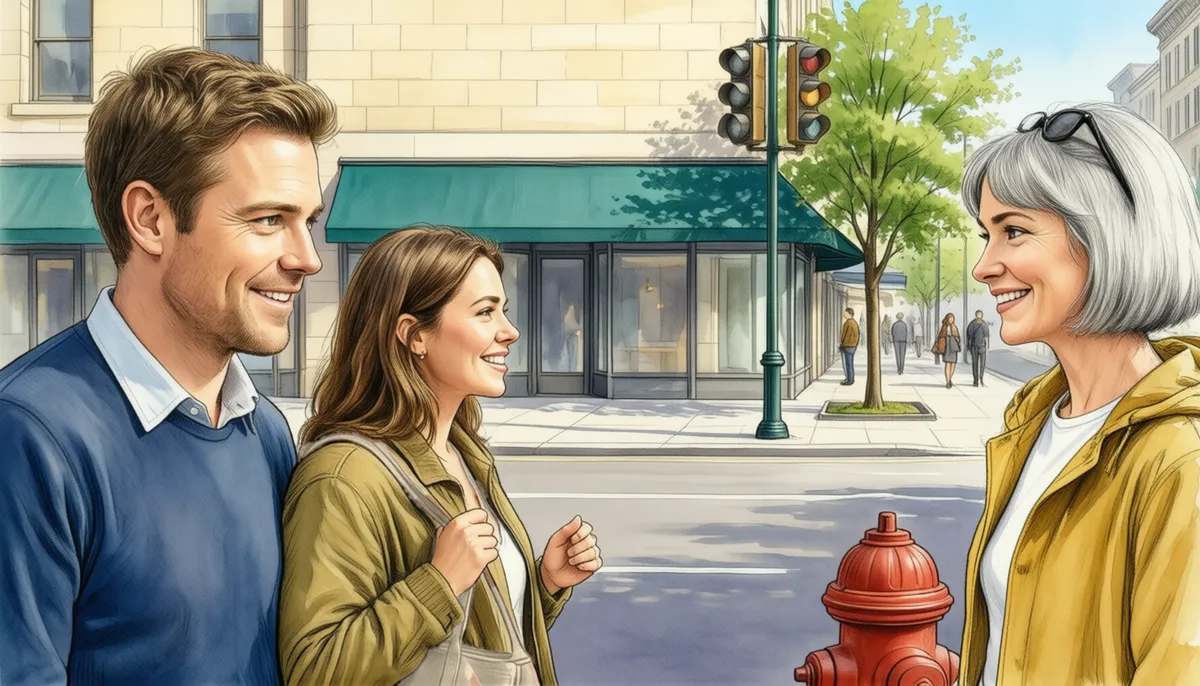
Mia: Excuse me, sorry to bother you. How do I get to the art museum from here?
how do I get to...? — ★ THE question of this lesson · also "Which way is...?" · "Where's the nearest...?" · "I'm trying to find..."
Gwen: Oh, you're close. Go straight down this street three blocks, then make a left at the light.
make a left · at the light — ★ Americans often MAKE a left or a right instead of turning · "hang a left" is the casual one · "the light" = the traffic light
Mia: Straight three blocks, then a left at the light.
saying it back — repeat the directions back in six words · it proves you understood and lets them fix it if you didn't
Gwen: That's it. Once you turn, it's about halfway down the block, on your right.
halfway down the block · on your right — down the block = along that street · "on your right" = the side you'll see it on, NOT another turn
Ben: How will we know it when we see it?
Gwen: It's the big gray building across from the library. You really can't miss it.
across from · you can't miss it — across from = opposite · next to = beside · "you can't miss it" = don't worry, it's big
Mia: And how long does that take on foot?
on foot — ★ on foot = walking · Americans measure a walk in MINUTES and BLOCKS, not in miles or kilometers
Gwen: Ten minutes, tops. It's a straight shot until you hit the light.
tops · a straight shot — tops = at the most · a straight shot = one straight road, no turns · "hit the light" = reach it
Ben: So we're headed the right way already?
headed the right way — ask it before you walk ten minutes · also "Am I going the right way?" · "Is this the right way to...?"
Gwen: You are. Just keep going the way you're facing.
Mia: Thank you so much. You've been a big help.
you've been a big help — the warm thank-you · also "You're a lifesaver." · "I really appreciate it."
Gwen: Happy to help. Enjoy the museum!
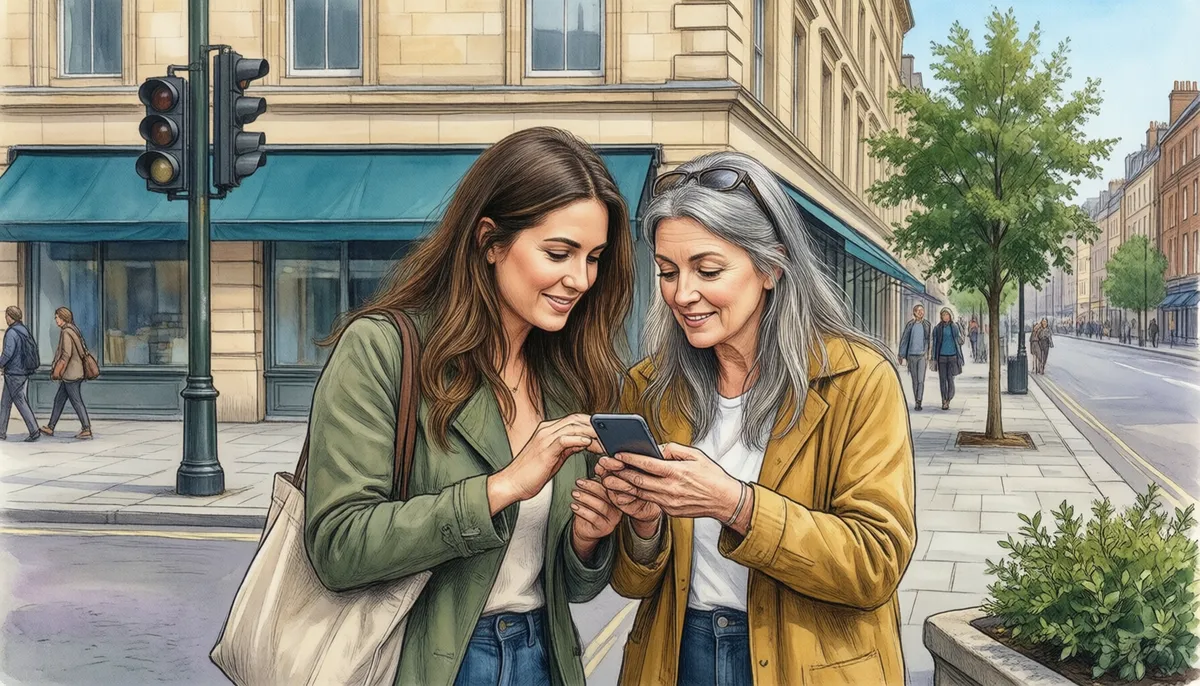
Mia: Sorry, could I ask you one more thing? We're trying to find the farmers market too.
one more thing — the polite bridge to a second question · also "Sorry, one more question."
Gwen: Sure. Go back up to Main, take a right, then ten blocks. It's behind the church.
go back up to · take a right — take a right = turn right · "go back up" / "go back down" = return the way you came · Main Street = the classic US main street
Mia: I'm sorry, could you say that one more time? A little slower?
one more time · a little slower — the two sentences that save every conversation · also "Sorry, I didn't catch that." · "Could you repeat the last part?"
Gwen: Of course. Go back up to Main Street. Take a right.
Mia: Back up to Main, take a right. Got it.
got it — got it = I understand · say it after EACH step, not at the end · also "Okay." · "With you so far."
Gwen: Then ten blocks. You'll pass a school on your left, then the square behind the church.
you'll pass · behind the church — landmarks are how Americans give directions · past / behind / in front of / next to / across from
Mia: Ten blocks, past a school, the square behind the church.
Gwen: You've got it.
Mia: Would you mind showing me on the map? I just want to be sure.
would you mind showing me? — when words fail, ask for the map · also "Could you show me where we are?" · "Can you point?"
Gwen: Not at all. We're here, and the market is right there.
not at all · we're here — "not at all" is a YES · it answers the MIND, not the favor · "we're here" = this dot is us
Mia: Oh, that is much clearer. Thank you, I really appreciate it.
that's much clearer — what you say when you finally understand · also "Now I see it." · "That makes sense."
Gwen: Any time. Good luck!
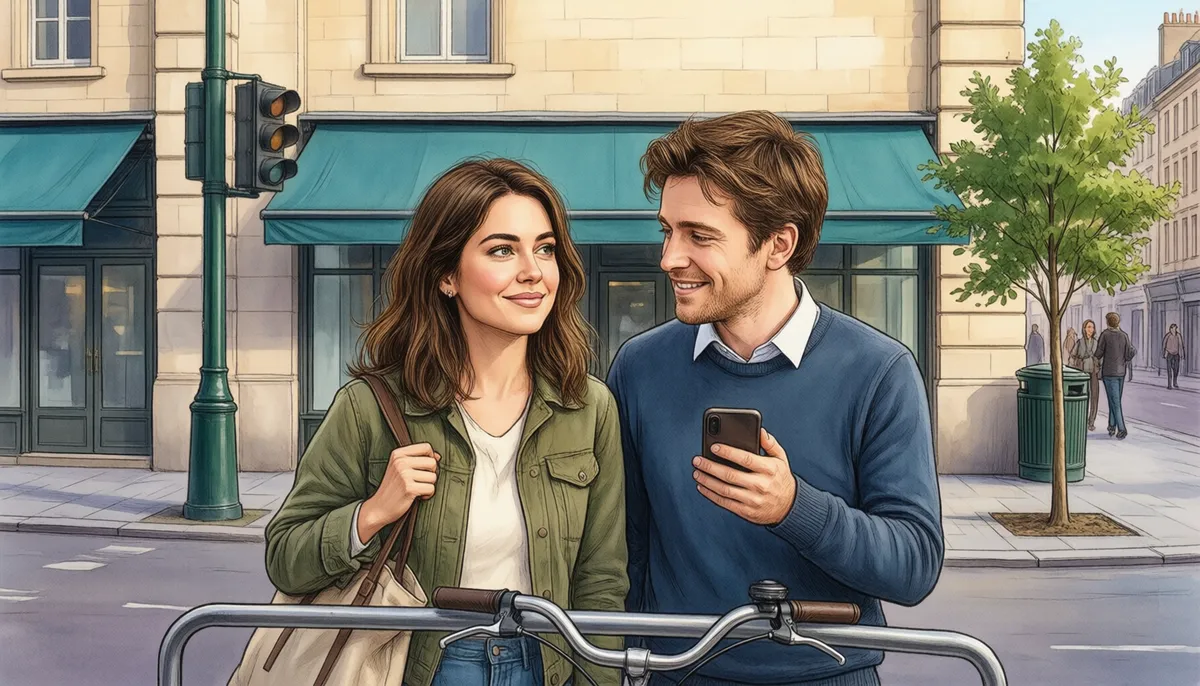
Mia: How far is the market from here? Is it walking distance?
how far · walking distance — walking distance = close enough to walk · also "Is it walkable?" · "Can I walk, or should I take the train?"
Ben: Hang on, let me look. It says twenty minutes on foot.
hang on · on foot — hang on = wait a second · also "Hold on." · "Give me a sec." · the app always answers in minutes
Mia: Twenty minutes is nothing. Is it a nice walk, or is it all parking lots?
Ben: Straight down Main, mostly shops. And it's flat.
straight down · flat — flat = no hills, an easy walk · uphill / downhill · "straight down Main" = along Main Street
Mia: What about the train? Would that be faster?
would that be faster? — comparing your options out loud · also "Is it quicker to walk?" · "What's the fastest way?"
Ben: Six minutes on the train. But the station is four blocks the other way.
four blocks the other way — ★ A BLOCK is the American unit of walking · one block = from one cross street to the next, a minute or two · "the other way" = the opposite direction
Mia: So by the time we walk there and wait for it.
by the time... — counting the time you lose getting to the fast thing · the sentence Americans leave unfinished on purpose
Ben: Exactly. We'd save maybe five minutes.
Mia: Then let's walk. It's a beautiful day and I'd rather see the city.
I'd rather — I'd rather = I prefer · "I'd rather walk." · "I'd rather not, honestly."
Ben: Works for me. Which way is Main, left or right?
works for me · which way is...? — works for me = fine by me, I agree · "Which way is...?" is the shortest question in the lesson
Mia: Left. I asked twice, remember?
Ben: You did. Lead the way.
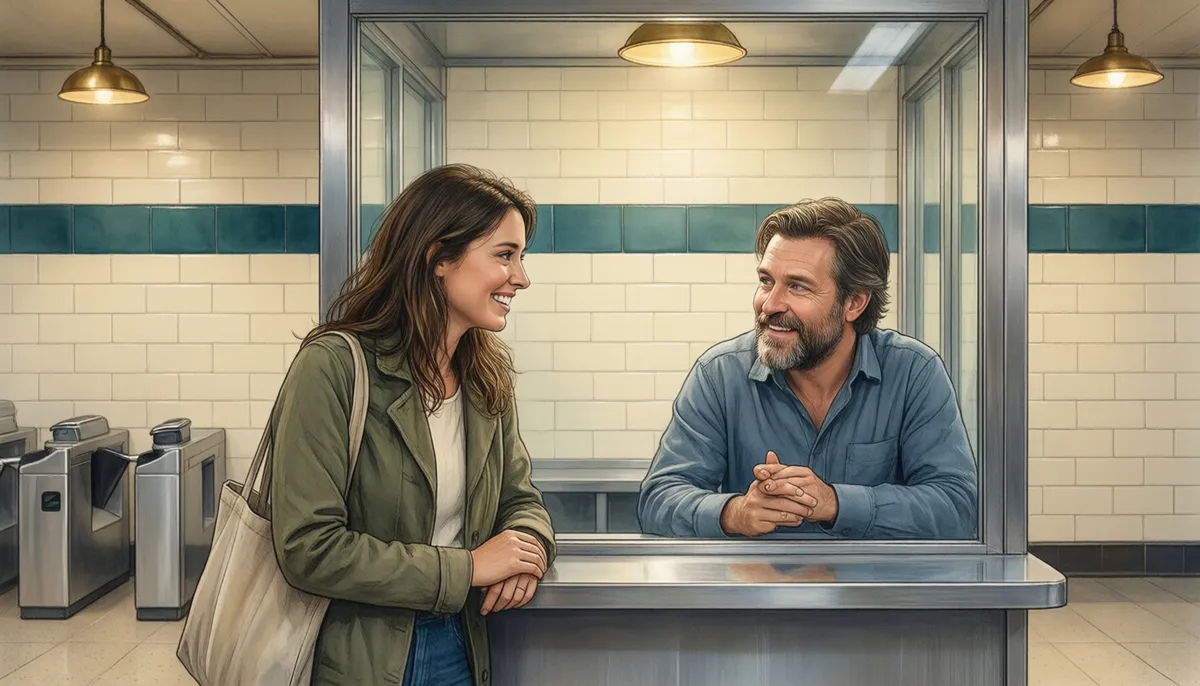
Mia: Excuse me, I've never used this. How do I pay?
I've never used this — say you're new and you get the whole answer · nobody in a US city minds this question
Curtis: You tap right at the turnstile. A credit card, your phone, your watch, whatever you've got.
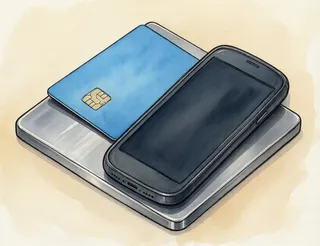
tap · the turnstile — tap your card · or your phone
Mia: I don't need a ticket at all?
Curtis: Not anymore. Tap the reader and walk through.
not anymore · walk through — ★ US transit in 2026: most big systems let you tap a contactless bank card, a phone or a watch right at the gate · no ticket to buy
Mia: And how much is it?
Curtis: Three dollars, and it's the same fare however far you go.
the fare · however far you go — ★ the fare = the price of one ride · on most US subways it is FLAT: one price, one stop or twenty · and you only tap on the way IN
Mia: What if I ride a lot in one week?
Curtis: Use the same card every time. After twelve rides the rest of the week is free.
the fare cap — ★ the fare cap · tap the SAME card every time and the system stops charging once you've paid the weekly price · no pass to buy
Mia: That's good to know. And which side do I want for downtown?
which side? · downtown — ★ downtown = toward the city center · uptown = away from it · on many subways each side goes ONE way, so ask before you go down
Curtis: Downtown is across the street, down those stairs. This side only goes uptown.
across the street · uptown — ★ THE TRAP: the two directions often have SEPARATE entrances · go down the wrong stairs and you pay again to cross
Mia: Across the street. Thank you, you just saved me a fare.
Curtis: That's what I'm here for. Have a good one.
have a good one — the everyday American goodbye to a stranger · also "Take care." · "Have a good one" answers itself: "You too."
Mia: Excuse me, does this train stop at Grand Street?
does this train stop at...? — ask BEFORE you get on · the same question works for a bus: "Does this bus go to...?"
Nadia: This one? No. That's the express, it skips Grand.
the express · it skips — ★ EXPRESS = fast, stops only at the big stations · LOCAL = slow, stops at every one · skip a stop = go past without stopping
Mia: Oh no. So which train do I want?
Nadia: The local. It stops at every station. The express only stops at the big ones.
the local — if you don't know, take the LOCAL · it is slower and it cannot leave you stranded
Mia: How do I know which one is coming?
Nadia: The board up there tells you. Local, four minutes. Express, one minute.
the board — the board = the countdown screen · it shows the line and the minutes · also "the arrivals board", "the sign"
Mia: Four minutes is fine. How many stops is Grand from here?
how many stops? — count in STOPS, not in minutes · "Five stops." · "It's the third stop." · "Two more and you're there."
Nadia: Five, I think. Ten minutes, give or take.
give or take — give or take = more or less · also "roughly", "or so", "about" · nobody promises an exact time
Mia: And I can wait anywhere on the platform?
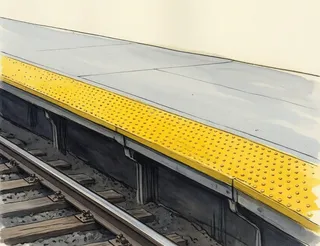
the platform edge — the platform · stand behind the line
Nadia: Anywhere. Just let people off before you get on. That's the one rule everybody cares about.
let people off first — ★ THE unwritten rule on every US subway and bus · stand to the SIDE of the doors · breaking it is the fastest way to annoy a city
Mia: Good to know. Thank you, you saved me a long ride.
Nadia: No problem. Take the next one, not this one.
Mia: Excuse me, was that Grand Street we just passed?
was that my stop? — the emergency sentence · also "Did we pass Grand?" · "Is this Grand Street?" · "What stop is this?"
Nadia: It was. Two stops ago, actually.
two stops ago — counting backwards in stops · "one stop back" · "you went two too far" · "you overshot it"
Mia: Oh no. I was looking at my phone and I missed it completely.
Nadia: It happens to everybody. Don't worry, it's an easy fix.
it happens · an easy fix — what a kind stranger says · "no big deal" · "don't worry about it" · "you're fine"
Mia: What should I do?
Nadia: Get off at the next stop, cross to the other platform, and take the train back.
cross to the other platform — ★ the fix for every missed stop · the other platform runs the OPPOSITE direction · often up the stairs and straight back down
Mia: Do I have to pay again?
Nadia: No. As long as you stay inside the station, you don't tap again.
you don't tap again — ★ changing trains inside the gates is FREE · walk out to the street and you pay a second fare
Curtis: This is Union Square. Transfer is available to the green line.
transfer is available — ★ the announcement at each stop · "transfer is available" = you can change lines here · when you hear "stand clear of the closing doors", step back
Mia: Is this where I get off?
get off · get on — you get ON and OFF a train, a bus and a plane · you get IN and OUT of a car · "this is my stop" = I'm getting off here
Nadia: This is it. Up the stairs, and right back down on the other side.
Mia: Up and back down. Thank you, I could have ended up anywhere.
ended up — end up = arrive somewhere you didn't plan · "I ended up across town." · "We ended up walking."
Nadia: Honestly, we've all done it. Good luck!
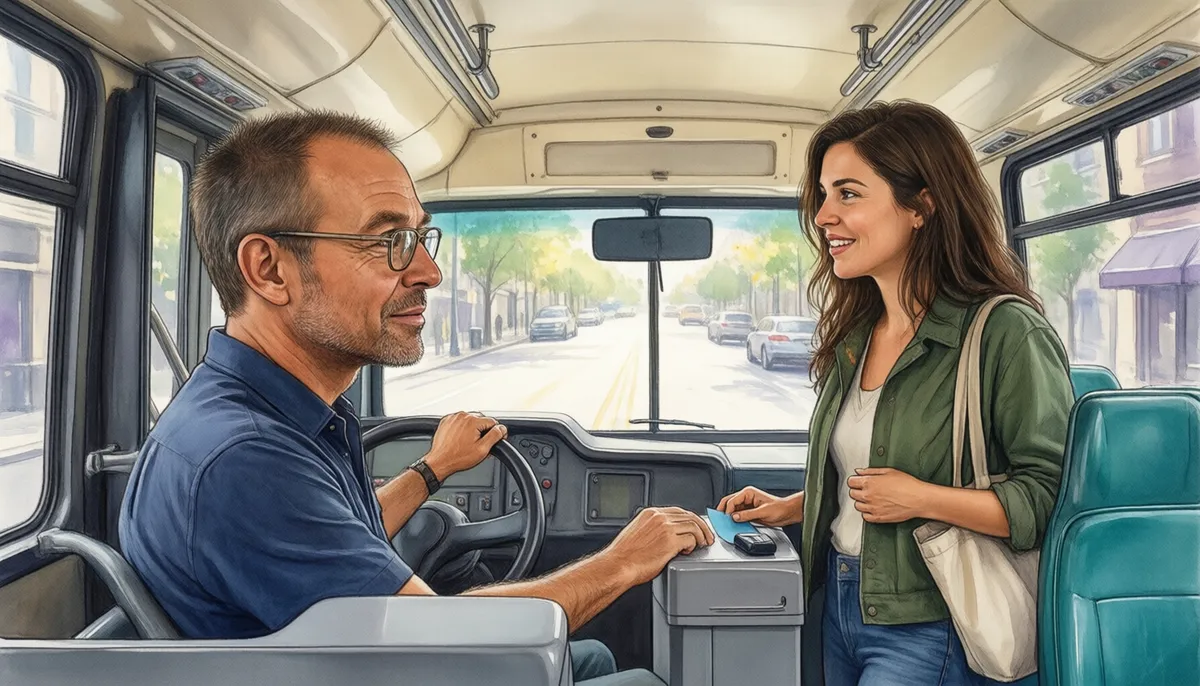
Mia: Good morning. Does this bus go downtown?
does this bus go to...? — ask the DRIVER, out loud, before you step up · also "Does this one go to Fifth?" · "Am I on the right bus?"
Otis: It does. Downtown, then it turns around and comes back up Fifth.
turns around · comes back up — a bus route usually runs out and back · "up" and "down" a street are directions, not hills
Mia: Great. How much is it?
Otis: Two seventy-five. Tap your card right there, or exact change in the box.
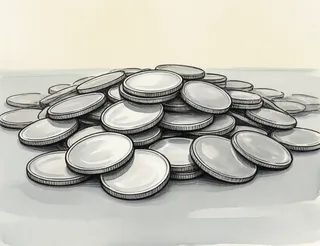
exact change — coins only
Mia: Exact change? You can't break a five?
break a five — break a bill = give change for it · "Can you break a twenty?" · on a US bus the answer is always no
Otis: I sure can't. No bills, no change given. Coins or a tap.
no change given — ★ a US bus farebox gives NO change · overpay and you lose it · some take only coins · this is why most people tap now
Mia: I'll tap, then. Like this?
Otis: Hold it flat until it beeps. There you go.
hold it flat · there you go — "there you go" = that worked · also "you got it", "that's it", "perfect"
Mia: And if I need another bus after this one?
Otis: You're good for two hours. Tap the same card and the second one is free.
you're good for two hours — ★ THE TRANSFER · one fare usually buys about two hours · tap the SAME card on the next bus or train and it's usually free
Mia: That's easy. How many stops to Fifth and Grand?
Fifth and Grand — ★ Americans name a place by its CROSS STREETS · "Fifth and Grand" = the corner where they cross · say it to a driver and they know exactly where you mean
Otis: About eight. Fifteen minutes if the lights are with us. Go on and grab a seat.
grab a seat — grab = take, quickly and casually · "grab a seat", "grab a coffee", "grab your bag"

Mia: Excuse me, is this seat taken?
is this seat taken? — ★ ask before you sit, even if it looks empty · the answers: "All yours." · "Go ahead." · "Sorry, my friend's coming back."
Pearl: All yours. Go ahead and sit.
all yours — = please take it, it's free · also "Go right ahead." · "Help yourself." · "Nope, sit down."
Mia: Thank you. Can I ask, do you know this route? I'm getting off at Fifth and Grand.
the route · getting off at — the route = the streets this bus follows · "I'm getting off at..." tells people what you need without asking for it
Pearl: I ride it every day. It's a few more stops. I'll tell you when.
I'll tell you when — you can ask for this · "Could you tell me when we get there?" · drivers and riders say yes almost every time
Mia: That's so kind. I was afraid I'd miss it.
Pearl: Don't be. And when it's coming up, you pull that cord by the window.
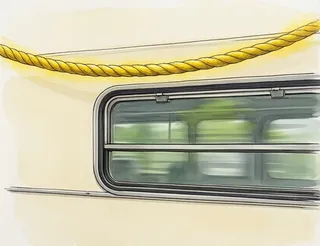
pull the cord — to request your stop
Mia: The yellow one?
Pearl: That's it. Or press the red strip by the door. Do it a block before your stop.
the red strip · a block before — ★ REQUEST YOUR STOP or the bus drives past · pull the cord or press the strip ONE BLOCK early · a light and a chime tell you it worked
Otis: Next stop, Fifth and Grand.
next stop — ★ the announcement to listen for · some drivers call it, some machines do, some do neither · count your stops as well
Pearl: There you go. That's you.
Mia: Front door or back door?
front door or back door? — ★ you get ON at the front and OFF at the BACK · push the door or touch the yellow strip when the light comes on
Pearl: Back door. Push it when the light comes on, and watch your step going down.
watch your step — watch your step = be careful where you put your feet · also "careful going down", "watch the gap"
Mia: Thank you so much. Have a good day!
Pearl: You too, hon. Take care.
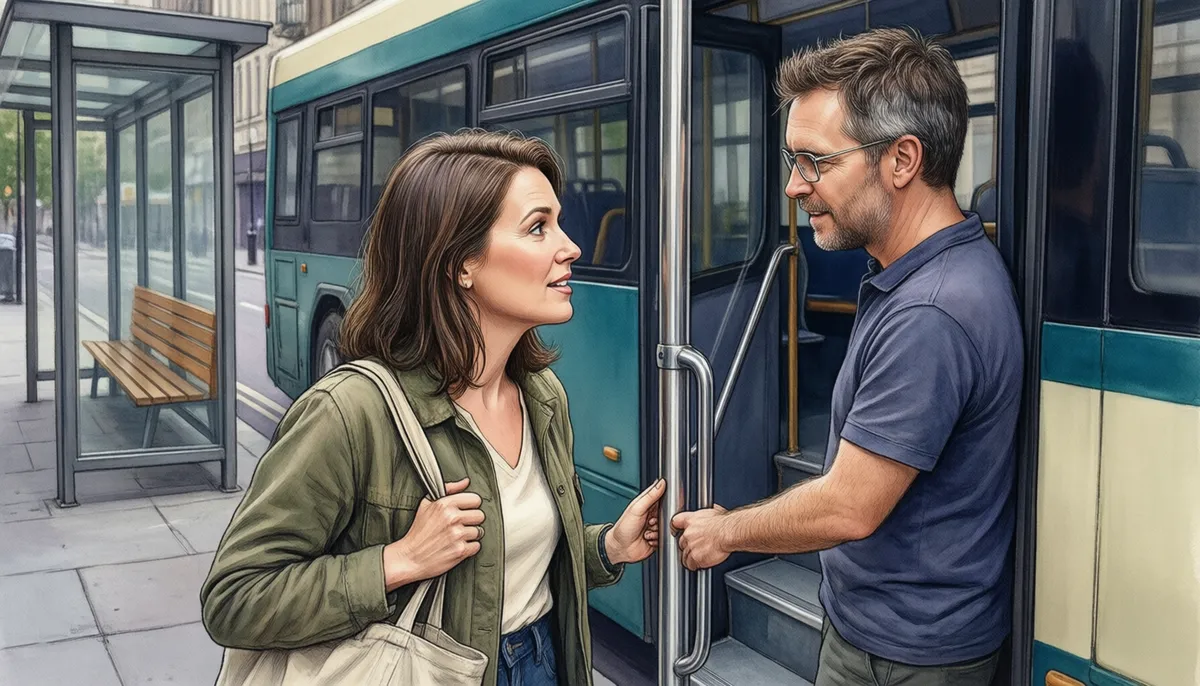
Mia: Excuse me, is this the forty-two?
the forty-two — ★ a US bus is its NUMBER · "the forty-two", "the nine", "the twelve" · nobody says "bus number forty-two"
Otis: It is, but we're on a detour today. There's construction on Ninth.
a detour · construction — ★ a detour = a changed route · construction = road work · also "a service change", "a shuttle bus"
Mia: A detour? So where does it go instead?
Otis: We turn at Seventh and come back down. We skip four stops in the middle.
we skip four stops — skip = go past without stopping · the same word the express train uses · "we're not stopping at Grand today"
Mia: I need Fifth and Grand. Do you still stop there?
Otis: Not today. Your best bet is to get off at Seventh and walk two blocks east.
your best bet · two blocks east — your best bet = the smartest option · also "you're better off walking", "if I were you I'd..."
Mia: Two blocks east. Is that back the way you came, or ahead?
back the way you came · ahead — the two answers to every direction question · also "turn around", "keep going", "double back", "it's behind you"
Otis: Ahead. You'll be walking toward the river. Keep the park on your left.
east · toward the river — ★ Americans give directions by COMPASS in grid cities · north, south, east, west · and by landmarks: toward the river, toward the park
Mia: Okay. Is there another bus that goes the whole way?
Otis: The nine does, but it only comes every half hour. You'd wait longer than you'd walk.
every half hour — how often a bus runs · "every ten minutes", "twice an hour", "on the hour" · "it runs till midnight"
Mia: Then I'll walk. Thank you for telling me.
Otis: You bet. Come on, hop on.
you bet · hop on — you bet = sure, no problem, you're welcome · hop on / hop in = get on or in, quickly · both are very American
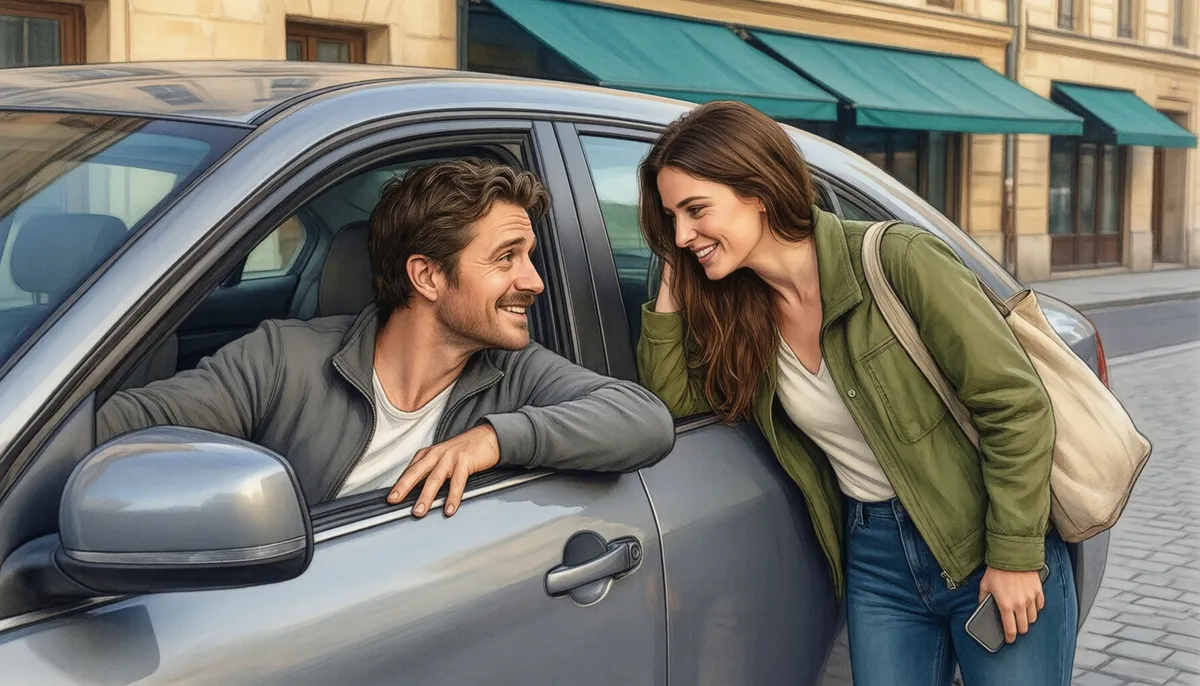
Sonny: Are you Mia?
let the driver say your name — ★ THE SAFETY RULE · never say your own name first · let the DRIVER say it · a real driver already has it on the screen
Mia: I am. Sorry, can I check the plate first?
the plate — ★ check THREE things before you get in: the license plate, the make and color of the car, and the driver's photo
Sonny: Please do. That's exactly what you should be doing.
Mia: Gray Corolla, and the last three numbers match. Perfect.
the last three numbers — how people really check a plate · "the last three" · "it ends in two one four" · say it out loud, it's normal
Sonny: And the app gives you a code. What is it?
the code in the app — ★ turn on the PIN in your rideshare app · the driver can't start the trip until you say the four digits
Mia: Four, seven, two, one.
Sonny: Got it. We're all set.
we're all set — all set = ready, done, taken care of · "Are you all set?" · "I'm all set, thanks" can also mean "no, thank you"
Mia: Thanks. Do you mind if I sit in the back?
do you mind if...? — ★ most US riders sit in the BACK, on the sidewalk side · the front seat is fine too, just ask · "do you mind if..." = may I
Sonny: Sit wherever you like. Just watch the door getting in, there's a bike lane.
watch the door · the bike lane — ★ open the door slowly and look back first · US cities put bike lanes between the car and the curb · "dooring" a cyclist is the danger
Mia: Good call. Is the drop-off still the address in the app?
good call · the drop-off — good call = good point, thanks · the pickup / the drop-off = where the ride starts and ends
Sonny: Fifth and Grand, yep. Fifteen minutes, maybe less.
Mia: No rush. Thank you.
no rush — = take your time, I'm not in a hurry · also "whenever you're ready", "no hurry", "take your time"
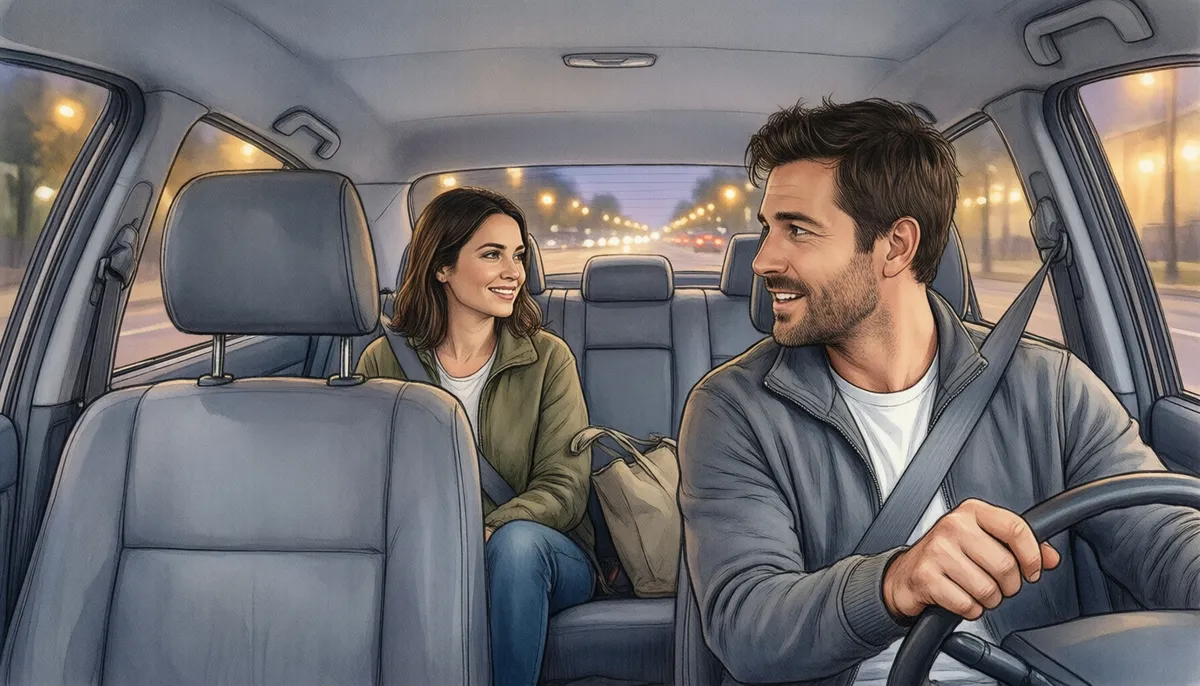
Sonny: Is the temperature okay back there? I can turn it up.
is the temperature okay? — the first thing a driver asks · answers: "It's perfect." · "A little cold, actually." · "Could you turn it down?"
Mia: It's perfect, thanks. Do you mind if I crack the window?
crack the window — crack = open a little · "roll down the window" = open it all the way · "roll it up" = close it
Sonny: Go right ahead. Nice evening for it.
Mia: How's traffic looking?
how's traffic looking? — the safest small talk in any US car · also "Busy night?" · "How long have you been driving?" · "Rough weather out there."
Sonny: Not bad. There's a backup on the bridge, so I'm taking the side streets.
a backup · the side streets — a backup = a line of stopped traffic · also "bumper to bumper", "gridlock", "it's crawling" · side streets = the small streets that go around it
Mia: You're the expert. I would have sat on that bridge for an hour.
Sonny: Everybody does. Music okay, or would you rather have it quiet?
Mia: Quiet is nice, honestly. It's been a long day.
quiet is nice — ★ you are allowed to want a quiet ride · "I'm just going to close my eyes, if that's okay." · no driver takes it badly
Sonny: Say no more.
Mia: Actually, there's a light up ahead. You can drop me right there at the corner.
drop me right here — drop me = let me out · "right here is fine", "anywhere along here", "just past the light" · a corner beats a doorway in traffic
Sonny: You sure? I can take you to the door.
Mia: The corner is perfect. Thank you, and I'll add the tip in the app.
the tip in the app — ★ TIPPING A DRIVER · you tip AFTER the ride, inside the app, usually fifteen to twenty percent or a couple of dollars · cash is welcome but rare
Sonny: I appreciate that. Have a good night, and don't forget your bag.
don't forget your bag — ★ every driver says it, and people still leave things · if you do: open the app, find the trip, "I lost an item" · it calls the driver for you
Mia: Got it. Thanks again!
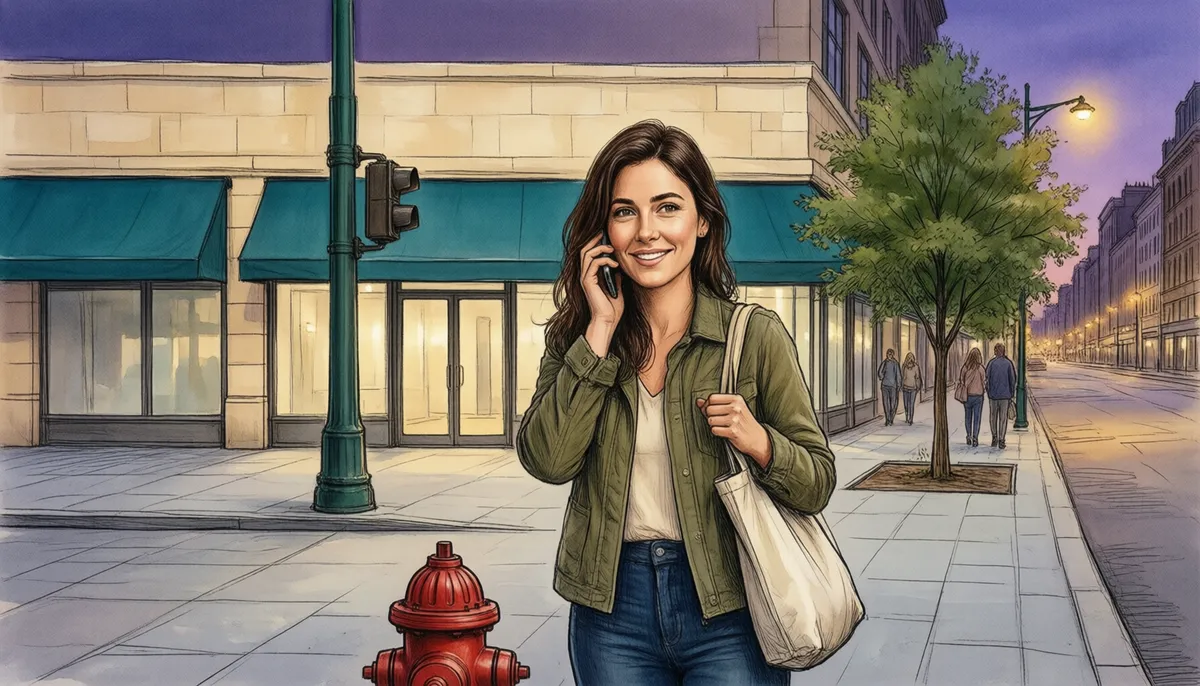
Vic: Hi, this is your driver. I'm at the pickup spot and I don't see you.
the pickup spot — ★ the app puts a PIN on the map and the driver drives to it · if the pin is wrong, the driver calls · pick up the phone, it is not a scam
Mia: Hi! I'm right outside the library. Where are you exactly?
where are you exactly? — answer with a LANDMARK, not an address · "outside the library" · "on the corner of Ninth and Pine" · "by the blue awning"
Vic: I'm on Ninth, in front of a bank, with a bus stop next to me.
Mia: Oh, I think you're on the other side of the street. I'm across from you.
the other side of the street — the number one reason a driver can't find you · also "I'm across from you" · "same side as the park" · "the odd-numbered side"
Vic: That would explain it. It's a one-way, so I can't turn around here.
a one-way street — ★ a one-way street runs in ONE direction · that is why a driver asks YOU to walk half a block, and why it's faster if you do
Mia: No problem. Do you want me to come to you, or should we meet at the corner?
meet at the corner — the phrase that ends the problem · also "I'll walk up to you." · "Stay where you are, I'll come around."
Vic: The corner is easier. The one with the traffic light.
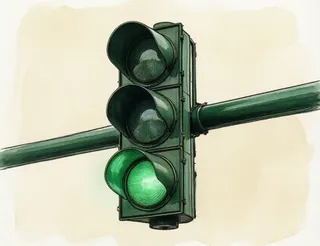
the corner with the light — the corner with the light
Mia: The corner with the light. Give me one minute.
Vic: Take your time. I'm the silver minivan with the hazards on.
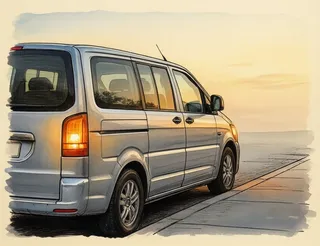
the hazards — how a driver shows you where they are
Mia: Silver minivan, hazards on. I see you, I'm waving.
Vic: I see you too. Stay right there, I'll pull up.
stay right there · pull up — pull up = drive over and stop beside you · pull over = stop at the side · pull out = leave the curb
Mia: Thank you for waiting. Sorry about the pin.
the pin — ★ the pin is the dot the app drops for the driver · check it BEFORE you order · tall buildings can throw it off by half a block
Vic: No worries. The app does that sometimes.
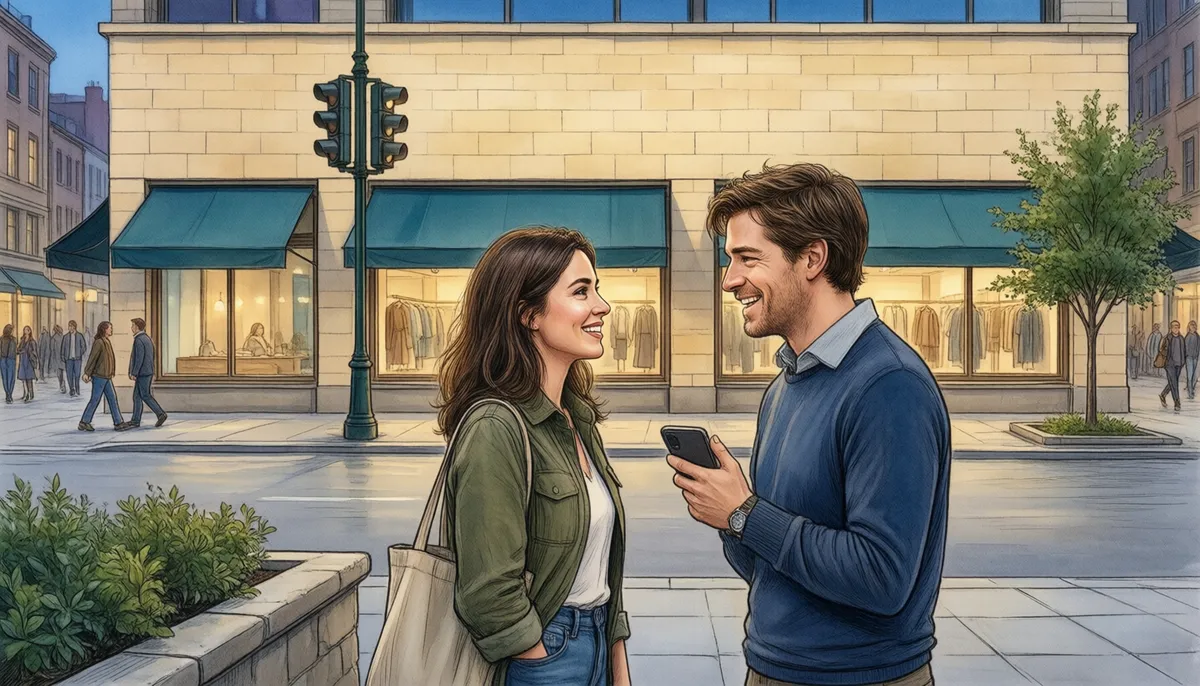
Mia: Wait. I think we're turned around.
turned around — turned around = facing the wrong way · softer than "lost" · also "I've got my bearings mixed up" · "I think we went the wrong way"
Ben: We can't be. The map said two blocks.
Mia: Two blocks from the station. We came out the other exit.
the other exit — ★ one station can have four exits on four corners · look for the exit sign with the street name BEFORE you climb the stairs
Ben: Ah. So we're two blocks off, in the wrong direction.
two blocks off — off = away from where you should be · "you're a block off" · "you overshot it" · "you went one too far"
Mia: Which way is north? Do you have a signal?
which way is north? — many US cities are GRIDS, and people really do answer in compass points · "three blocks north" · "the west side" · "head east"
Ben: Barely. The blue dot keeps jumping around.
the blue dot · a signal — the blue dot = you on the map · "I've got no signal" · "it's recalculating" · "my phone's about to die"
Mia: Look at the numbers on the buildings. Four hundred, four fifty, they're going up.
the numbers on the buildings — ★ THE TRICK NOBODY TEACHES · US house numbers climb in one direction · read two of them and you know which way you're walking
Ben: And we want two hundred. So we double back.
double back — double back = go back the way you came · also "turn around", "go back two blocks", "retrace your steps"
Mia: We double back. And we're going to be late.
Ben: Ten minutes, maybe. I'll text Raj and say we're on our way.
on our way — on our way = we've left, we're coming · "we're five minutes out" · "we're almost there" · "running about ten behind"
Mia: Tell him to start without us.
start without us — the polite thing to say when you're late · also "Don't wait for us." · "Go ahead and order." · "So sorry, we got turned around."
Ben: Done. Okay, turn around, and it's a straight shot from here.
Mia: Now it's a straight shot. Now that we're facing the right way.
Ben: Okay, okay. You can laugh at me on the way.
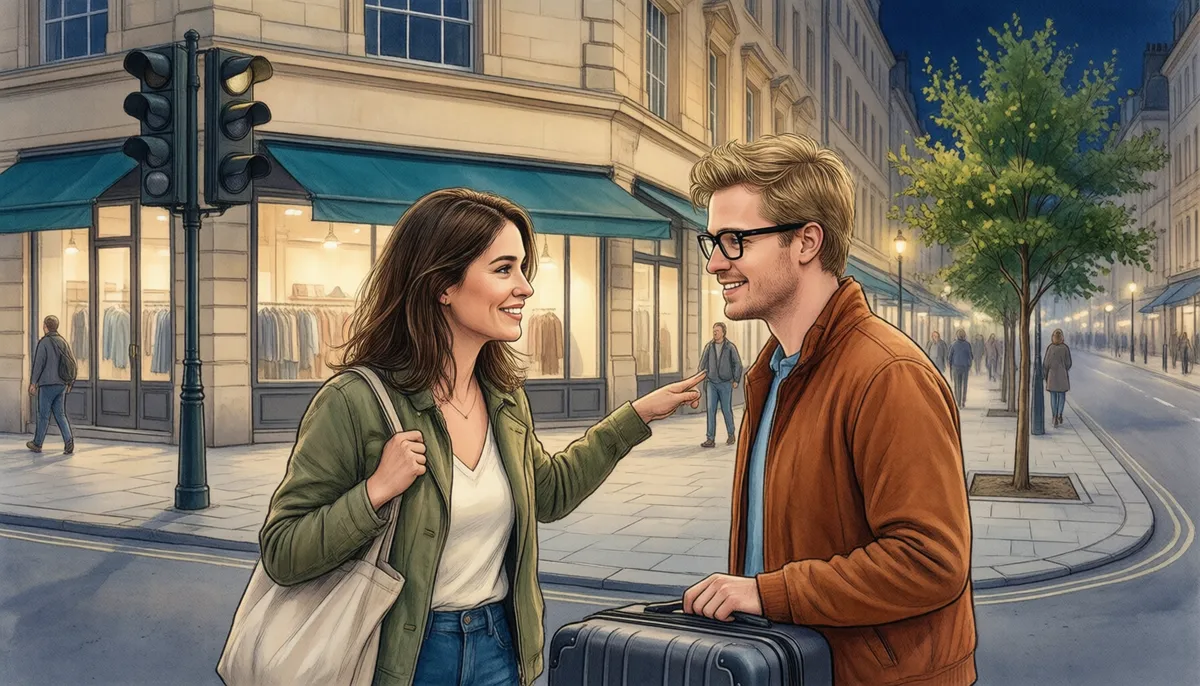
Hugo: Excuse me, do you know how to get to the Riverside Hotel?
do you know how to get to...? — the softest version of the question · "do you know..." lets the other person say no without feeling rude
Mia: I do, actually. It's about a ten-minute walk. Are you okay with that bag?
a ten-minute walk — how Americans answer "how far" · always in MINUTES · "a five-minute walk" · "twenty minutes on foot" · "a good half hour"
Hugo: If it's ten minutes, sure.
Mia: Go down this street two blocks, past the bank, and make a right at the second light.
giving directions in order — give ONE step at a time, in walking order · distance, then a landmark, then the turn · short sentences, and stop
Hugo: Two blocks, past the bank, right at the second light.
Mia: Then one more block, and the hotel is on your left, across from a park.
on your left · across from — finish with the SIDE of the street and one landmark · that is the part people actually remember
Hugo: On my left, across from a park. Is there a sign?
Mia: A big green one. You can't miss it.
you can't miss it — the traditional last line of every American direction · it is a promise, and it is usually true
Hugo: And if I get lost?
if I get lost — get lost = stop knowing where you are · "I got lost." · "Don't get lost!" · different from "lose" something
Mia: Ask anybody. Or take a picture of my phone, it's right here on the map.
take a picture of the map — the most useful modern move · a photo works with no signal · also "I'll drop you a pin" · "let me text you the address"
Hugo: That's smart. Thank you, you just saved me a taxi.
Mia: Any time. Welcome to the city!
any time — any time = you're welcome, gladly · also "No problem at all." · "Happy to help." · "Sure thing."

Ivy: Sorry, is this the right station for the airport?
is this the right station? — the same shape as every question in this lesson · "Is this the right bus for...?" · "Am I in the right place for...?"
Mia: Right station, wrong line. You want the blue line, downstairs.
the line · downstairs — ★ a LINE is one route · US cities name them by color (the blue line), by letter (the A) or by number (the six)
Ivy: Downstairs. Do I need a ticket?
Mia: No ticket. Tap your card or your phone at the turnstile. Three dollars.
tap your card or your phone — no ticket, no machine, no line · any contactless bank card, phone or watch · the card IS the ticket
Ivy: That's all? And when I get off?
Mia: You don't tap again. Only on the way in.
only on the way in — ★ on most US subways you tap IN and never OUT · a few systems make you tap out too · if in doubt, ask, or watch the person ahead of you
Ivy: Perfect. How many stops is it?
Mia: Six stops to Union, then you transfer to the green line. The transfer is free.
you transfer · the transfer is free — ★ transfer = change trains · inside the gates it costs nothing · "change at Union" means the same thing
Ivy: Six stops, then the green line. How long altogether?
Mia: Forty minutes, give or take. Faster than a car at this hour.
at this hour — at this hour = at this time of day · "rush hour" = the busy morning and evening · "off peak" = the quiet times
Ivy: And downstairs is the right direction?
Mia: Look for the Union Square sign before you go through. The wrong stairs cost you another fare.
before you go through — ★ CHECK THE DIRECTION BEFORE THE TURNSTILE · once you tap, crossing to the other side can cost a second fare
Ivy: Good to know. Thank you so much, you're a lifesaver.
you're a lifesaver — the biggest everyday thank-you · also "You've been a huge help." · "I owe you one." · "I can't thank you enough."
Mia: You're welcome. Have a safe trip!