
Advanced English Vocabulary — Smart Words in Plain English
Advanced English vocabulary, explained in plain English. Each "smart" word comes in real sentences — and under every sentence you see the SAME sentence in simple English, so you know exactly which plain words the smart word replaces.
Every lesson teaches 9 advanced words (B2-C1) around one everyday theme. For each word you:
- hear it said clearly, with its stress (muh-TIK-yuh-lus)
- see a picture and a short meaning
- read and hear 3 example sentences, each with its plain-English twin
Then the quiz turns it around: you get the simple sentence, and you pick the smart word that fits.
No lists to memorize. Every word comes with real sentences, a picture, and a short note on how native speakers actually use it: its usual partners, its opposite, and when it sounds formal.
HOW TO USE THIS PLAYLIST
- Say each smart sentence out loud, right after the voice.
- In the quiz, answer before the countdown ends. Pause if you need a moment.
- Come back a week later and take the quiz again. If you still know a word, it is yours.
- Use one new word today — in a message, an email, or a comment under a video.
LESSONS
- 01 · Describing People — meticulous, gregarious, frugal, candid, gullible, eccentric, tenacious, pragmatic, sanguine
- 02 · At Work — consensus, feasible, mitigate, scrutinize, incentive, tentative, proactive, caveat, acumen
- 03 · Arguments & Opinions — concede, refute, plausible, adamant, contentious, fallacy, rhetoric, digress, insinuate
Coming next:
- 04 · Feelings & Moods — ambivalent, apprehensive, elated, melancholy, indignant, apathetic, jaded, serene, mortified
- 05 · Money & Spending — lucrative, affluent, exorbitant, squander, windfall, haggle, meager, austerity, reimburse
- 06 · Talking & Communication — articulate, succinct, eavesdrop, tactful, jargon, euphemism, colloquial, allude, banter
New lessons are on the way. Subscribe so the next 9 words find you.
-
Lesson 1
9 Advanced English Words to Describe People (with Simple Meanings)
🧠 Smart Words in Plain English — Lesson 1: Describing People
Learn 9 advanced English words to describe people: meticulous, gregarious, frugal, candid, gullible, eccentric, tenacious, pragmatic and sanguine. Each word comes with three example sentences, and right under every sentence you see the SAME sentence in simple English — so you see exactly which plain words the smart word replaces.
Watch on YouTube →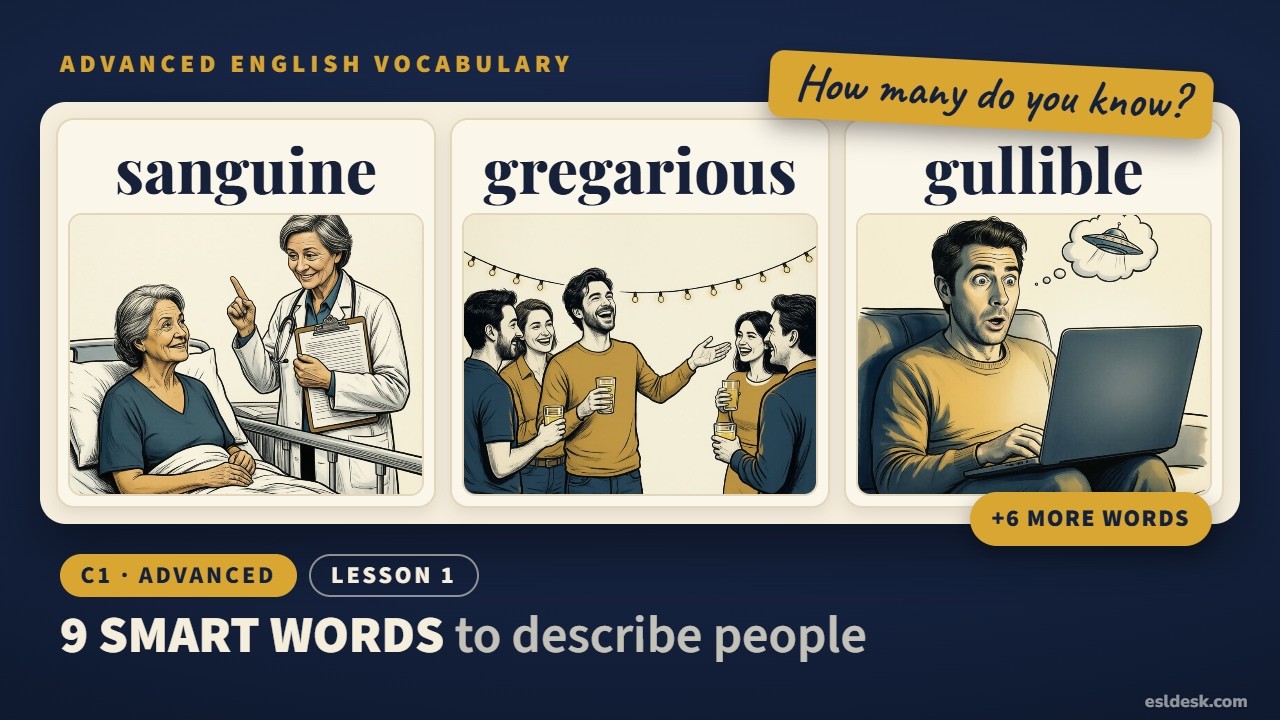 8:43
8:43
📍 Chapters — jump into the video
- 0:00 The word that is NOT in the dictionary
- 0:21 meticulous — very careful about every small detail
- 0:56 gregarious — loves being around other people
- 1:30 frugal — careful not to waste money
- 2:03 candid — honest and direct
- 2:31 gullible — believes things too easily
- 3:03 eccentric — strange, but in a harmless, interesting way
- 3:35 tenacious — keeps going and doesn't give up
- 4:08 pragmatic — practical; focused on what really works
- 4:42 sanguine — calm and hopeful, even when things look bad
- 5:14 Quiz — 18 questions: which smart word fits?
-
Lesson 2
9 Advanced English Words for Work (with Simple Meanings)
🧠 Smart Words in Plain English — Lesson 2: At Work
Learn 9 advanced English words for work: consensus, feasible, mitigate, scrutinize, incentive, tentative, proactive, caveat and acumen. Each word comes with three example sentences, and right under every sentence you see the SAME sentence in simple English — so you see exactly which plain words the smart word replaces.
Watch on YouTube → 9:15
9:15
📍 Chapters — jump into the video
- 0:00 The polite way to say no at work
- 0:24 consensus — an agreement that almost everyone accepts
- 0:59 feasible — possible and practical to do
- 1:33 mitigate — make something bad less serious
- 2:08 scrutinize — examine something very closely
- 2:41 incentive — a reward that makes you want to do something
- 3:18 tentative — not final; it may still change
- 3:52 proactive — acts early, before problems start
- 4:30 caveat — a warning or a condition you add
- 5:11 acumen — sharp judgment, especially in business
- 5:43 Quiz — 18 questions: which smart word fits?
-
Lesson 3
9 Advanced English Words for Arguments and Discussions (with Simple Meanings)
🧠 Smart Words in Plain English — Lesson 3: Arguments & Opinions
Learn 9 advanced English words for arguments and discussions: concede, refute, plausible, adamant, contentious, fallacy, rhetoric, digress and insinuate. Each word comes with three example sentences, and right under every sentence you see the SAME sentence in simple English — so you see exactly which plain words the smart word replaces.
Watch on YouTube →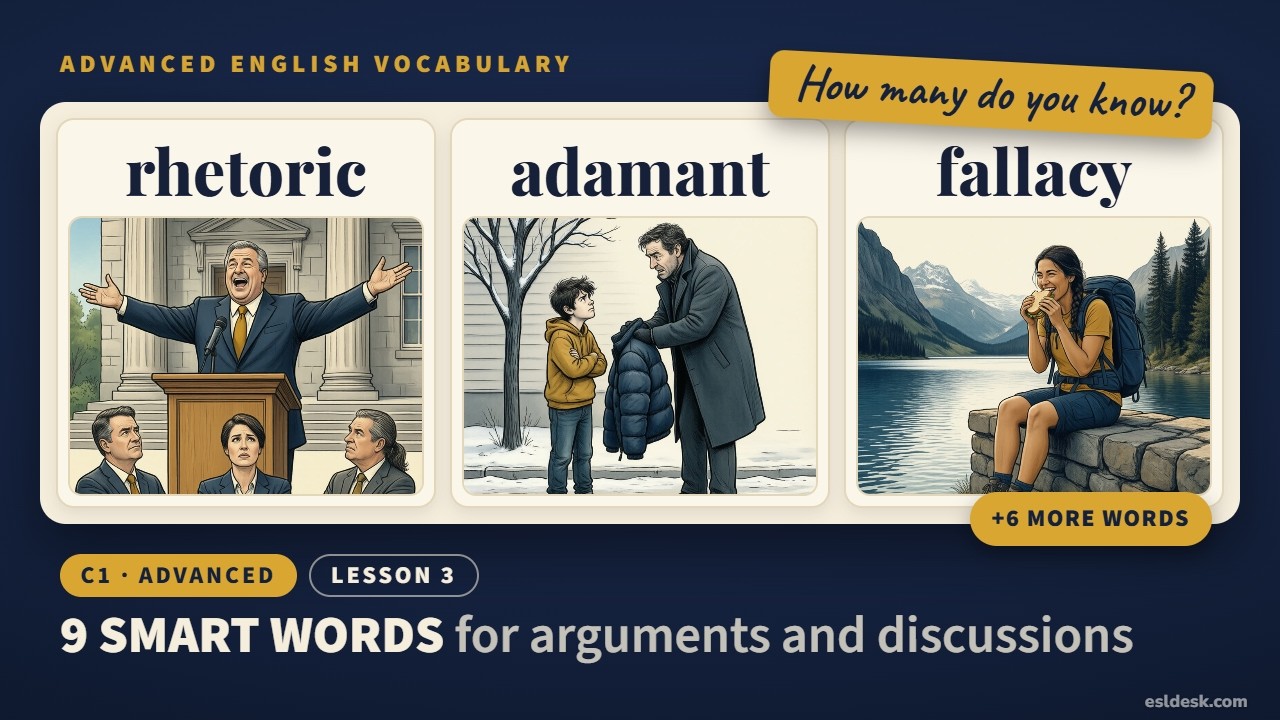 8:47
8:47
📍 Chapters — jump into the video
- 0:00 How to accuse someone without saying it
- 0:25 concede — admit something is true, even when you don't want to
- 1:01 refute — prove that something is wrong
- 1:34 plausible — seems reasonable and could easily be true
- 2:10 adamant — completely sure; won't change your mind
- 2:45 contentious — likely to cause arguments
- 3:16 fallacy — a false idea that many people believe
- 3:49 rhetoric — persuasive words, often without real meaning
- 4:25 digress — wander away from the main topic
- 5:01 insinuate — hint at something bad without saying it
- 5:31 Quiz — 18 questions: which smart word fits?