
Doctor English — Real English for the Doctor & Pharmacy
The complete spoken-English series for medical situations: book an appointment, describe your symptoms, get through the exam, ask about a prescription, handle the pharmacy counter, understand dosage instructions, deal with urgent care, and follow up when you're feeling better. Every lesson is a real conversation taught line by line — natural speed first, then a slow repeat you can say out loud — with the meaning of each phrase and short culture notes on how things actually work at a US clinic. American-English audio for beginner and intermediate learners. New lessons from .
-
Lesson 1
Booking a Doctor's Appointment in English: What to Say | Doctor English #1
Doctor English ➔ Lesson #1 Everything you actually say to book a doctor's appointment by phone in English: asking for a visit, giving your reason, choosing a time, sharing your name and date of birth, and what to bring as a new patient. You hear the whole call at natural speed, practice every line slowly, then review the key question-and-answer pairs.
🗣️ Phrases you'll learn — tap 🔊 to hear
- I'd like to make an appointment (book a visit)
- This is my first time (you're a new patient)
- I've had a cough for a week (give a short reason)
- Do you have anything earlier? (ask for a sooner time)
- My name and date of birth (the details they ask for)
- What should I bring? (as a new patient)
- Thanks for your help. See you then (confirm and close)
🌎 Culture notes in this lesson
- Clinics ask "Is it urgent?" to prioritize — say it's not urgent for routine visits.
- Always repeat the day and time back to confirm.
- Giving your full name and date of birth is normal and helps them find your file faster.
Watch on YouTube → 4:16
4:16
📍 Chapters — jump into the video
-
Lesson 2
How to Describe Your Symptoms to a Doctor in English — What to Say | Doctor English #2
Doctor English ➔ Lesson #2 Everything you actually say to tell a doctor how you feel in English: explaining what's wrong, saying where it hurts, how long you've had it, whether it's getting worse, naming symptoms like fever and cough, and rating your pain from one to ten. You hear the whole visit at natural speed, practice every line slowly, then review the key question-and-answer pairs.
🗣️ Phrases you'll learn — tap 🔊 to hear
- What brings you in today? (how the doctor asks why you came)
- I don't feel well / I've been feeling sick since Monday (say you're sick + since when)
- My throat really hurts (name the painful spot)
- It's getting worse (describe the trend)
- Do you have a fever? / I keep coughing (common symptoms)
- On a scale of one to ten… I'd say about a seven (rate your pain)
- No, I think that's everything (you've listed all your symptoms)
🌎 Culture notes in this lesson
- Be specific about where it hurts — the more exact you are, the easier it is to diagnose.
- Always say when it started and how long it's lasted ("since Monday," "for about three days").
- Doctors ask you to rate pain from 1 to 10 — give a number, even a rough one.
Watch on YouTube → 4:10
4:10
📍 Chapters — jump into the video
-
Lesson 3
English at the Doctor — The Examination (Slow + Natural) | Doctor English #3
Doctor English ➔ Lesson #3 Everything you actually hear and say during a doctor's physical exam in English: the doctor starting the check-up, guiding your breathing, looking at your throat, taking your temperature and blood pressure, giving the diagnosis, and telling you what to do to get better. You hear the whole exam at natural speed, practice every line slowly, then review the key question-and-answer pairs.
🗣️ Phrases you'll learn — tap 🔊 to hear
- Let me take a look at you (the doctor starts the exam)
- Take a deep breath… now breathe out slowly (follow the breathing cues)
- Open wide and say ahh (for the throat check)
- Your throat is quite red (what the doctor finds)
- Let's check your temperature / blood pressure (routine checks)
- It's just a bad cold, nothing serious (the diagnosis)
- Get plenty of rest and drink water (the advice)
🌎 Culture notes in this lesson
- The doctor guides your breathing — just do each step as they say it.
- "Open wide and say ahh" lets the doctor check your throat.
- The diagnosis tells you what's wrong and how serious it is ("just a bad cold," "not the flu").
Watch on YouTube →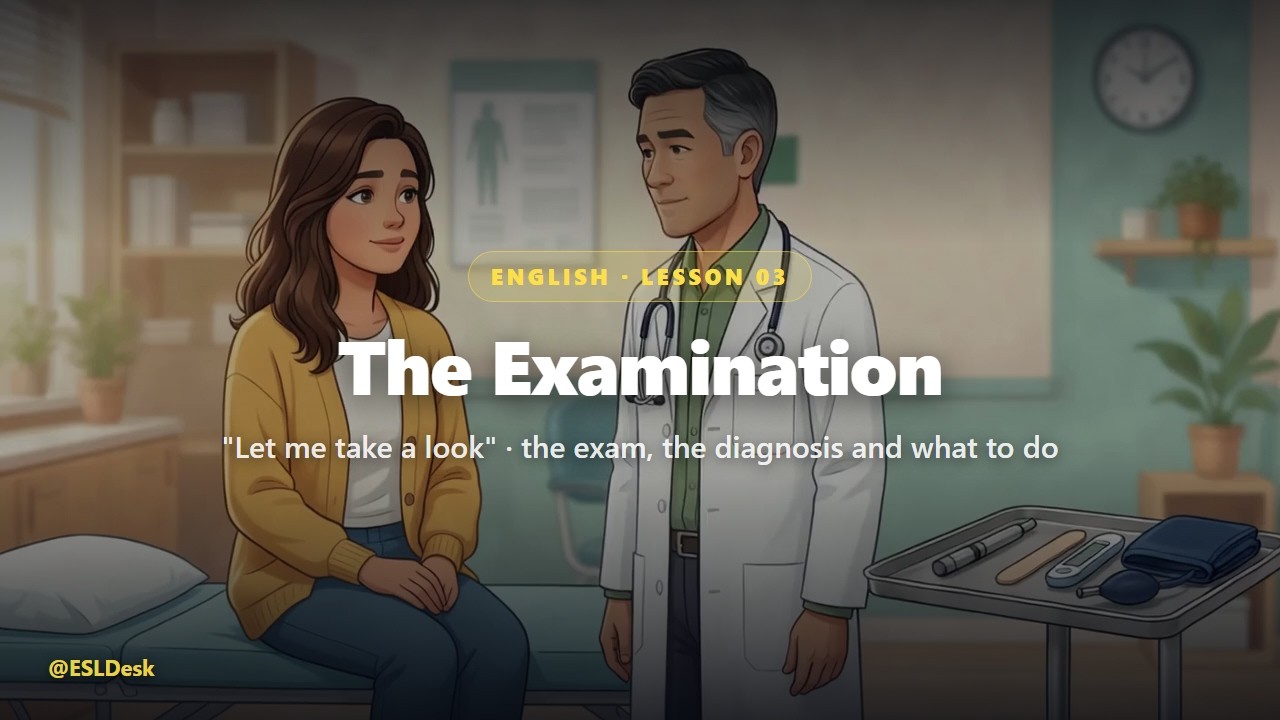 4:01
4:01
📍 Chapters — jump into the video
-
Lesson 4
Do I Need a Prescription? — At the Doctor in English, Step by Step | Doctor English #4
Doctor English ➔ Lesson #4 Everything you actually say and hear when the doctor prescribes medicine in English: asking if you need a prescription, finding out if it's pills or liquid and how often to take it, asking what the medicine is for, telling the doctor about an allergy, and learning where and how to fill it at the pharmacy. You hear the whole conversation at natural speed, practice every line slowly, then review the key question-and-answer pairs.
🗣️ Phrases you'll learn — tap 🔊 to hear
- Do I need a prescription? (ask if you need medicine)
- Is it pills or liquid? / One every morning (the form and how often)
- What's this medicine for? — It clears up the infection (what it treats)
- I'm allergic to penicillin (name your allergy)
- How do I fill the prescription? (get the medicine made up)
- Hand this slip to the pharmacist / Take it to any pharmacy (where to go)
- Just finish all the pills (take the whole course)
🌎 Culture notes in this lesson
- An antibiotic is medicine that fights a bacterial infection — the doctor decides if you need one.
- Always tell the doctor about drug allergies (like penicillin) before they prescribe anything.
- To "fill" a prescription means getting the medicine made up — you hand the slip to a pharmacist (many US clinics can also send it ahead for you).
Watch on YouTube →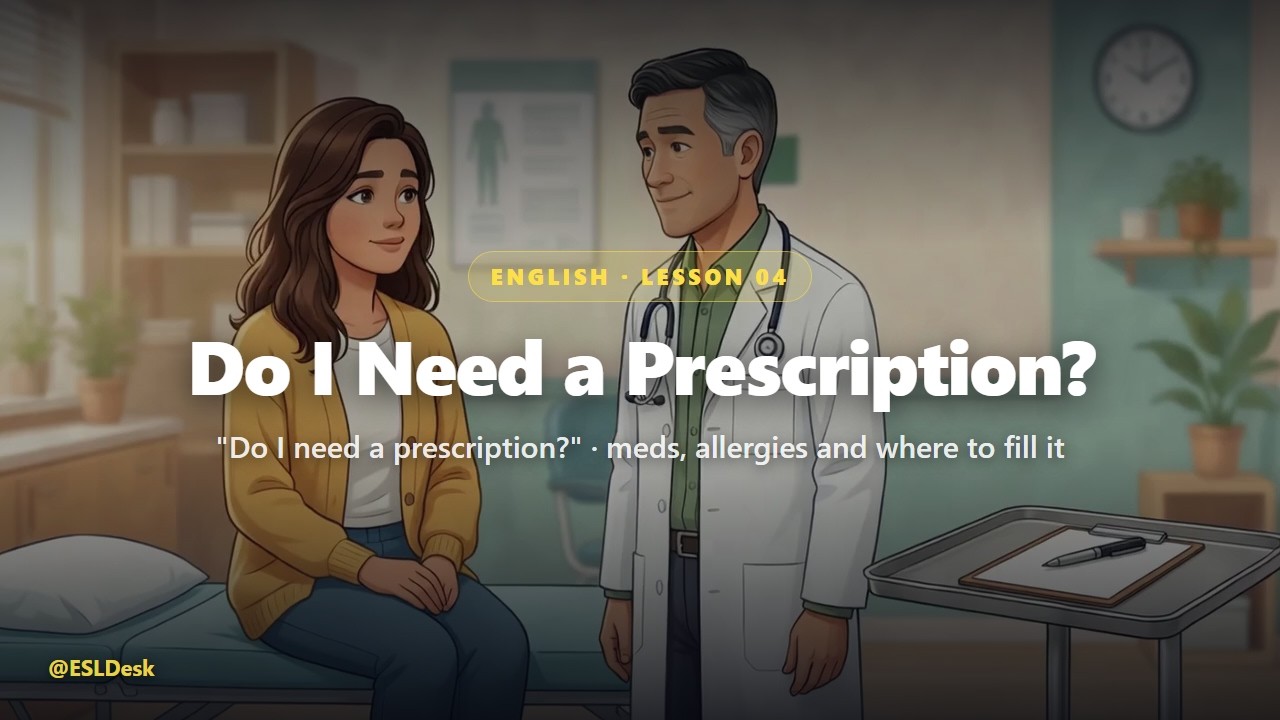 3:52
3:52
📍 Chapters — jump into the video
-
Lesson 5
At the Pharmacy in English — Drop Off, Pick Up, Insurance & Pay | Doctor English #5
Doctor English ➔ Lesson #5 Everything you actually say at the pharmacy counter in English: dropping off a prescription, asking when it'll be ready, picking it up, checking whether it's covered by insurance and how much you owe, choosing the cheaper generic, and asking for something over the counter. You hear the whole visit at natural speed, practice every line slowly, then review the key question-and-answer pairs.
🗣️ Phrases you'll learn — tap 🔊 to hear
- I'd like to drop off a prescription (hand it in to be filled)
- When will it be ready? — It'll take about fifteen minutes (the wait)
- I'm here to pick up a prescription (collect it)
- Is this covered by my insurance? / How much do I owe? (paying)
- Would you like the generic? — Same medicine, lower price (saving money)
- Do you have anything for a cough? — you can buy it over the counter (no prescription)
🌎 Culture notes in this lesson
- You "drop off" a prescription to be filled, then "pick it up" once it's ready.
- "Covered" means your insurance pays most of it — you pay a small copay.
- A "generic" is the same medicine as the brand name, at a lower price.
- "Over the counter" means you can buy it without a prescription.
Watch on YouTube →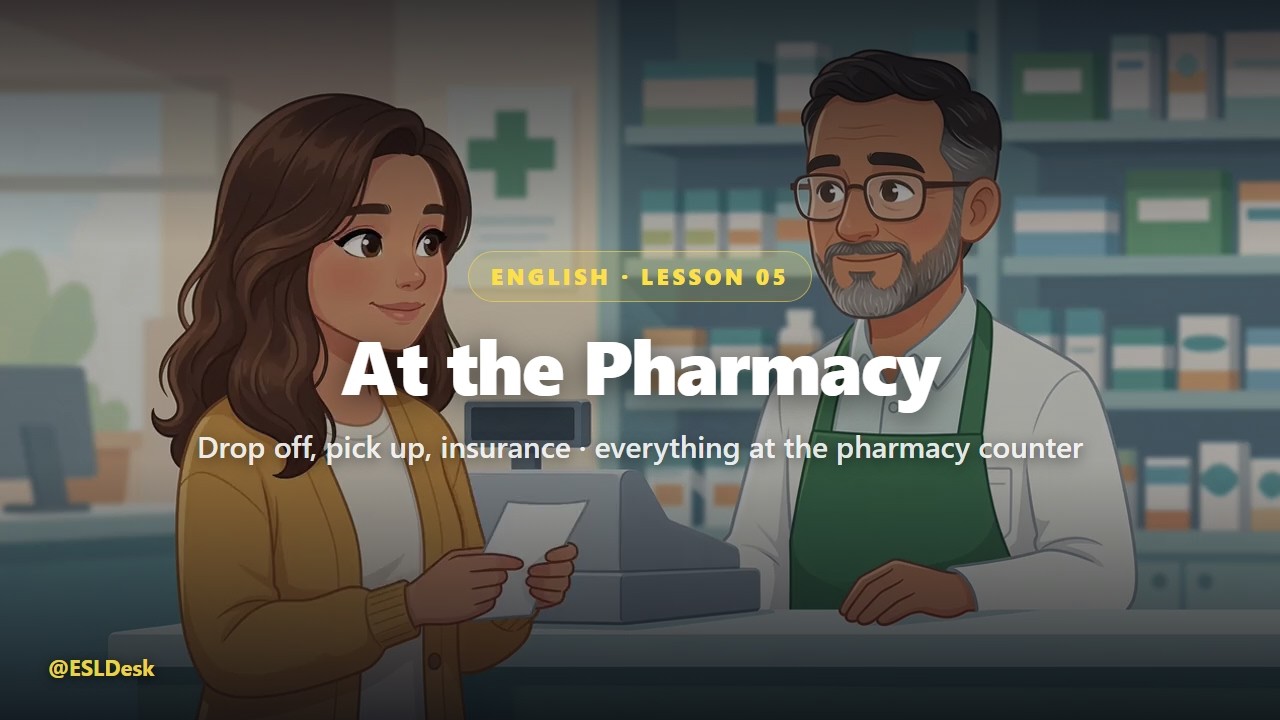 3:35
3:35
📍 Chapters — jump into the video
-
Lesson 6
Medicine Instructions in English: Dosage, Side Effects & Finishing the Course | Doctor English #6
Doctor English ➔ Lesson #6 Everything you actually say and hear about how to take your medicine in English: asking the dosage, how often and how far apart, whether to take it with food, what to do if you miss a dose, side effects, mixing it with your other pills, how to store it, and why you finish the whole course. You hear the whole conversation at natural speed, practice every line slowly, then review the key question-and-answer pairs.
🗣️ Phrases you'll learn — tap 🔊 to hear
- How do I take this medicine? — Take one pill twice a day (the dosage)
- Morning and night? — about twelve hours apart (the timing)
- Should I take it with food? — Yes, with a meal (food)
- What if I forget a dose? — just take the next one as usual (a missed dose)
- Are there any side effects? — it may make you a little sleepy (side effects)
- Can I take it with my other pills? — they don't mix badly (mixing medicines)
- Keep it somewhere cool and dry / out of reach of kids (storing it)
- Finish the whole course / don't stop early (finishing the medicine)
🌎 Culture notes in this lesson
- "Twice a day" means two doses about 12 hours apart — usually morning and night.
- "Side effects" are other things a medicine can cause (like drowsiness) — ask before you drive.
- Finish the whole "course" — every pill — even after you feel better, so it fully works.
Watch on YouTube →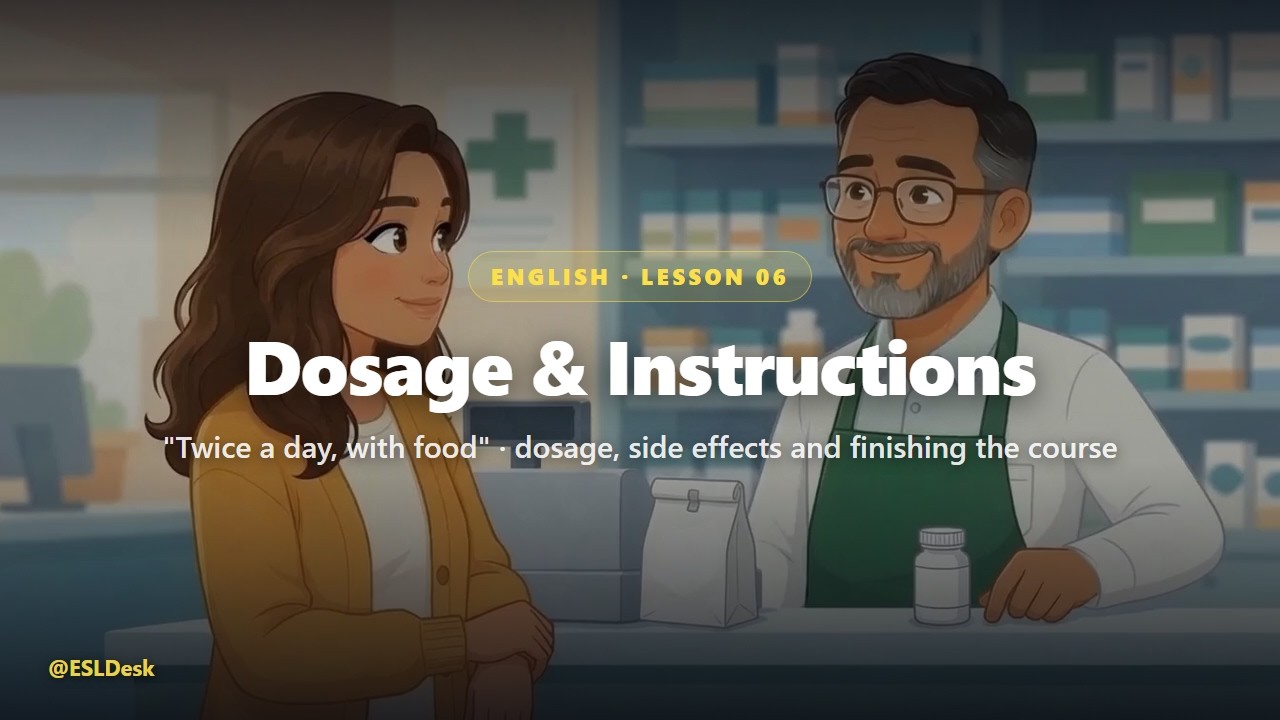 3:46
3:46
📍 Chapters — jump into the video